Introducing Agent Workbench: Professional Investment Research Powered by Agentic AI
When a hedge fund analyst asks "What drove Apple's services revenue growth in Q3 2025, and is it sustainable?"—they're not looking for a plausible-sounding paragraph. They need exact revenue figures from the 10-Q, management's specific commentary from the earnings call, forward guidance on sustainability, and cross-validation across SEC filings, earnings releases, and financial databases. A single incorrect number or misattributed quote can derail a multi-million dollar investment decision.
This is why generic LLM chat interfaces—ChatGPT, Claude, Gemini—fail professional investors. They weren't built for the precision, auditability, and data rigor that institutional investment research demands. They hallucinate numbers. They mix quarters. They cite outdated sources. They can't show their work.
Today, we're launching Agent Workbench—the first agentic-native platform purpose-built for professional US stock investors, portfolio managers, and investment analysts who need institutional-grade accuracy, comprehensive data coverage, and research-native workflows.
Agent Workbench delivers:
- Institutional data sources: SEC filings, earnings transcripts, sell-side research, expert networks, and proprietary intelligence—automatically structured and time-stamped
- 95%+ accurate agentic search: Multi-agent orchestration with iterative verification, not single-pass retrieval
- Research-first interface: Tabular data displays, source citations on every claim, interactive dashboards, and multi-document synthesis—designed for investment workflows, not casual chat
This isn't ChatGPT for finance. It's a professional research platform that happens to be powered by AI.
The Problem: Why Generic AI Chat Tools Fail Professional Investors
Investment Research Requires Institutional-Grade Precision
Professional investment research operates under constraints that general-purpose AI tools weren't designed to handle:
1. Absolute Accuracy on Numbers
When an analyst asks about Q3 2025 revenue, "approximately $22 billion" isn't good enough. The correct answer is $22.3 billion (from the 10-Q, page 3, Consolidated Statements of Operations). The difference between $22.0B and $22.3B—$300 million—can change valuation assumptions, investment theses, and portfolio allocation decisions.
Generic LLM chat interfaces routinely produce plausible-but-wrong numbers because they're optimized for conversational fluency, not numerical precision.
2. Multi-Source Verification Requirements
Investment decisions demand cross-validation across multiple authoritative sources:
- SEC filings (10-K, 10-Q, 8-K, S-1, DEF-14A) for audited financial statements
- Earnings call transcripts for management commentary and forward guidance
- Sell-side research for consensus estimates and analyst sentiment
- Expert network interviews for primary research and industry insights
- Financial databases (Bloomberg, FactSet, S&P Capital IQ) for historical comparisons
A single source isn't sufficient. Professional analysts verify every material claim against 2-3 independent sources before trusting it for investment decisions.
Generic AI systems retrieve from one source and confidently present unverified information—a workflow that violates institutional research standards.
3. Temporal Precision: The Right Data at the Right Time
Financial data is time-sensitive. Q3 2025 earnings are fundamentally different from Q2 2025 or Q3 2024. Fiscal quarters don't align with calendar quarters. Guidance changes quarter-to-quarter. Restatements happen.
Generic AI tools frequently mix time periods, cite outdated guidance as current, or retrieve historical data when fresh information exists. For investment research, temporal misalignment creates catastrophic errors.
4. Auditability and Source Transparency
Institutional investors must audit every claim in their research. Compliance teams review investment memos. External auditors validate methodologies. Regulators scrutinize decision-making processes.
"The AI said so" isn't a defensible answer. Every number, every claim, every conclusion needs explicit source attribution with page numbers, document identifiers, and timestamps.
Generic LLM chat interfaces provide conversational responses without source citations, making audit trails impossible to reconstruct.
5. Complex Multi-Document Synthesis
Professional investment analysis requires synthesizing information across dozens of documents:
- Compare Apple's Q3 2025 results to Q3 2024, Q2 2025, and analyst consensus
- Contrast management's guidance in the earnings call with prior quarter commentary
- Identify discrepancies between 10-Q disclosures and earnings release headlines
- Track segment revenue trends across 8 quarters of filings
- Map competitor performance across 5-10 companies simultaneously
This multi-document, multi-quarter, multi-entity synthesis is far beyond what single-query chat interfaces can handle.
The Real Cost of Generic AI in Finance
The failure modes aren't hypothetical. Professional investors using generic LLM chat tools report:
- 30% accuracy on financial Q&A: Numbers are wrong, time periods are mixed, sources are outdated (FinanceBench benchmarks)
- Hallucinated citations: AI confidently cites documents that don't exist or attributes claims to wrong sources
- Temporal confusion: Mixing fiscal vs. calendar quarters, citing historical guidance as current
- Unit errors: Millions vs. billions confusion causing 1,000x magnitude errors
- No provenance: Impossible to trace where numbers came from or verify accuracy
These aren't minor inconveniences—they're deal-breakers. A hedge fund analyst who has to manually verify every AI-generated number spends more time fact-checking than if they'd done the research manually. The promise of AI-augmented research collapses into AI-created busywork.
The Solution: Agent Workbench for Professional Investment Research
Agent Workbench was built from first principles to solve the institutional investor's accuracy, coverage, and workflow problems. It's not a general-purpose chatbot adapted for finance—it's a research platform designed specifically for professional investment analysis.
Architecture Philosophy: Three Core Features
Agent Workbench is built around three core features that distinguish it from generic AI tools:
Core Feature 1: Institutional-Grade Data Sources
Core Feature 2: 95%+ Accurate Agentic Search
Core Feature 3: Research-First Interface and Workflow
Let's explore each feature in depth.
Core Feature 1: Institutional-Grade Data Sources
Generic AI tools train on broad web content—Wikipedia, news articles, public forums, scraped websites. This works for general knowledge questions but fails catastrophically for professional investment research, where data quality, freshness, and authority determine whether insights are actionable or misleading.
Agent Workbench integrates the same institutional data sources that professional analysts already trust, transforming unstructured disclosures and proprietary intelligence into structured, queryable context.
Company Filings & Investor Relations: From Raw Disclosures to Structured Signals
Data Coverage:
- SEC & Global Filings: Automated ingestion of 10-K, 10-Q, 8-K, S-1/424B, 13-D/G, Form 3/4/144, DEF-14A, S-4, and equivalent international filings
- NLP-Based Extraction: Financial metrics, risk factors, management commentary, segment breakdowns, and footnote disclosures automatically parsed and time-stamped
- IR Communications: Earnings call audio/transcripts, investor conference slides, quarterly IR decks integrated with longitudinal comparison of tone, guidance changes, and language shifts
Use Case: Detect subtle management tone divergence before guidance revisions; track consistency between narrative disclosures and quantitative filings.
Example:
When an analyst asks "How has Apple described its services growth strategy over the past 4 quarters?", Agent Workbench retrieves:
- Q3 2025 10-Q: "Services revenue grew 12% YoY driven by App Store, cloud services, and advertising"
- Q3 2025 Earnings Call: Management highlighted "expanding installed base reaching all-time high as sustainable growth driver"
- Q2 2025 10-Q: "Services revenue grew 8% YoY with strength in subscription services"
- Q2 2025 Earnings Call: Management noted "pricing optimization in App Store and cloud contributing to margin expansion"
The system identifies the shift in growth drivers (installed base expansion in Q3 vs. pricing optimization in Q2) and flags this as a strategic evolution worth investigating.
Sell-Side Research: Institutional-Grade Consensus Intelligence
Data Coverage:
- Coverage Reports: Initiation reports, quarterly previews/updates, flash notes, model revisions, industry outlooks, focus lists, and event takeaways from top-tier brokerages
- Normalization Engine: Converts narrative insights and model deltas into structured factors—target price revisions, rating trends, and sentiment scores
- Consensus Tracking: Aggregates analyst estimates, identifies outliers, and tracks consensus drift around catalysts
Use Case: Identify consensus drift or coverage intensity shifts around upcoming catalysts; benchmark your internal view versus the Street in real time.
Example:
When an analyst asks "What's the sell-side consensus on Apple's Q4 2025 revenue outlook?", Agent Workbench synthesizes:
- 15 analyst reports published in past 30 days
- Consensus revenue estimate: $124.5B (range: $120.2B - $127.8B)
- 3 analysts revised estimates upward (bullish on iPhone 17 cycle)
- 2 analysts revised estimates downward (concerned about China demand)
- Sentiment trend: Neutral-to-positive (60% buy ratings, 35% hold, 5% sell)
This structured consensus view enables the analyst to benchmark their internal forecast against the Street and identify where their view diverges.
Expert Networks & Channel Intelligence: Qualitative Depth, Quantitative Structure
Data Coverage:
- Channel Checks: Data from suppliers, distributors, competitors, and end users, standardized into comparable operational metrics and demand signals
- Domain Experts & Former Executives: Structured summaries of industry dynamics, management insights, competitive landscapes, and product-level feedback
- Management Interactions: Q&A summaries and meeting transcripts with C-level executives, mapped to thematic clusters (growth, risk, M&A, product pipeline)
- Peer Interviews & SME Insights: Analyst or consultant notes encoded into searchable fact units and cross-referenced with comparable entities
Use Case: Validate bottom-up assumptions; quantify qualitative insights from fragmented expert commentary.
Example:
When an analyst asks "What are suppliers saying about Apple's component orders for Q1 2026?", Agent Workbench retrieves:
- 3 expert network interviews with Asian component suppliers (past 45 days)
- Supplier A: "Orders increased 15% QoQ, suggesting strong iPhone demand"
- Supplier B: "Mix shifting toward premium components, indicating higher ASP expectations"
- Supplier C: "Lead times extending from 6 weeks to 8 weeks, sign of demand acceleration"
The system converts qualitative supplier commentary into actionable demand signals that the analyst can use to validate or challenge consensus forecasts.
In addition to these sources, Agent Workbench can also incorporate your proprietary research notes and broader market context (news, media, and sentiment signals), so you can search and synthesize across both internal and external inputs in one place.
Data Architecture: Built for the Way Analysts Actually Work
Agent Workbench doesn't just ingest data—it structures, contextualizes, and ranks information for analysis-ready retrieval:
- Automatic time-stamping: Every data point tagged with publication date, fiscal period, and "as of" date
- Entity linking: Canonical company identifiers across all sources (Apple Inc. = AAPL = ticker 0000320193 = CIK)
- Native parsers: Financial table extraction, segment breakdowns, footnote parsing, audio transcript alignment
- Fuzzy-tolerant retrieval: Understands industry nuance and terminology ("COGS" = "Cost of Goods Sold" = "Cost of Sales")
- Source ranking: Prioritizes authoritative sources (SEC filings > earnings releases > brokerage articles)
- Data lineage: Every fact traces back to verified source with page number, timestamp, and confidence score
This structured data foundation enables the agentic search layer to retrieve accurate, time-aligned, and auditable information at scale.
Core Feature 2: 95%+ Accurate Agentic Search
Having institutional-grade data is necessary but not sufficient. The critical challenge is retrieval and verification—ensuring that when an analyst asks a complex question, the AI returns the right information, from the right sources, with verified accuracy.
Traditional Retrieval-Augmented Generation (RAG) systems achieve only 25-30% accuracy on financial question-answering tasks. Agent Workbench achieves 95%+ accuracy through agentic search—a multi-agent orchestration architecture with iterative verification, adaptive tool selection, and comprehensive cross-source validation.
(For the full technical deep-dive, see our post updated in Nov. 2025: Achieving 99% Accuracy in Financial AI: Why Agentii Chose Agentic Search Over RAG)
Why Traditional RAG Fails: The 30% Accuracy Ceiling
Traditional RAG operates through a simple three-stage pipeline:
- Convert user query to vector embedding
- Retrieve semantically similar document chunks from vector database
- Pass retrieved context to LLM for answer generation
This works for general knowledge questions but fails catastrophically in financial applications:
Financial terminology is poorly embedded: Generic embedding models can't distinguish "derivative" (financial instrument) from "derivative" (mathematical concept) or "reserve" (banking capital) from "reserve" (inventory accounting).
Single-pass retrieval misses multi-source validation: RAG retrieves from one source and generates an answer. Professional investment research requires cross-validation across SEC filings, earnings calls, and financial databases.
Temporal misalignment: RAG retrieves semantically similar chunks without understanding fiscal quarters, restatements, or guidance updates. Mixing Q3 2024 and Q3 2025 data creates nonsensical answers.
No verification loop: If the retrieved context is incomplete or wrong, RAG generates a confident but incorrect answer. No self-correction mechanism exists.
The result: 30% accuracy on financial benchmarks, making RAG unsuitable for high-stakes investment decisions.
Agentic Search: Multi-Agent Orchestration for 99% Accuracy
Agent Workbench implements agentic search—a fundamentally different architecture that mirrors how expert human analysts work:
Human Analyst Workflow:
- Decompose complex question into sub-queries
- Search strategically across multiple sources
- Extract data carefully, checking units and time periods
- Calculate accurately using consistent methodologies
- Verify rigorously across sources, flagging discrepancies
- Synthesize clearly with full provenance
Agentic Search Mirrors This:
- Orchestrator Agent: Decomposes queries, routes sub-tasks to specialized agents, manages workflow
- Retriever Agents: Multiple specialized retrievers (vector search, BM25 keyword search, SQL queries, web search) run in parallel
- Extractor Agent: Financial table parsing, segment analysis, risk identification, management commentary extraction
- Verifier Agent: Cross-source validation, numerical agreement checks, temporal alignment, business logic validation
- Synthesizer Agent: Combines information from multiple agents, resolves conflicts, generates natural language with source citations
Finance-Native Agent Tool Stack
Agent Workbench's agentic search relies on finance-targeted tools designed specifically for real-world filings and market data:
- Financial table extractors: Parse balance sheets, income statements, cash flow statements, segment breakdowns
- Unit normalization: Convert thousands/millions/billions, handle FX conversions, align fiscal vs. calendar periods
- Temporal alignment: Match "as of" dates, handle restatements, track guidance changes
- Entity resolution: Canonical company identifiers across sources (ticker, CIK, name variations)
- Domain-specific validation: Check accounting identities, validate segment rollups, flag unusual entries
These specialized tools enable reliable, high-accuracy answers that generic retrieval systems can't match.
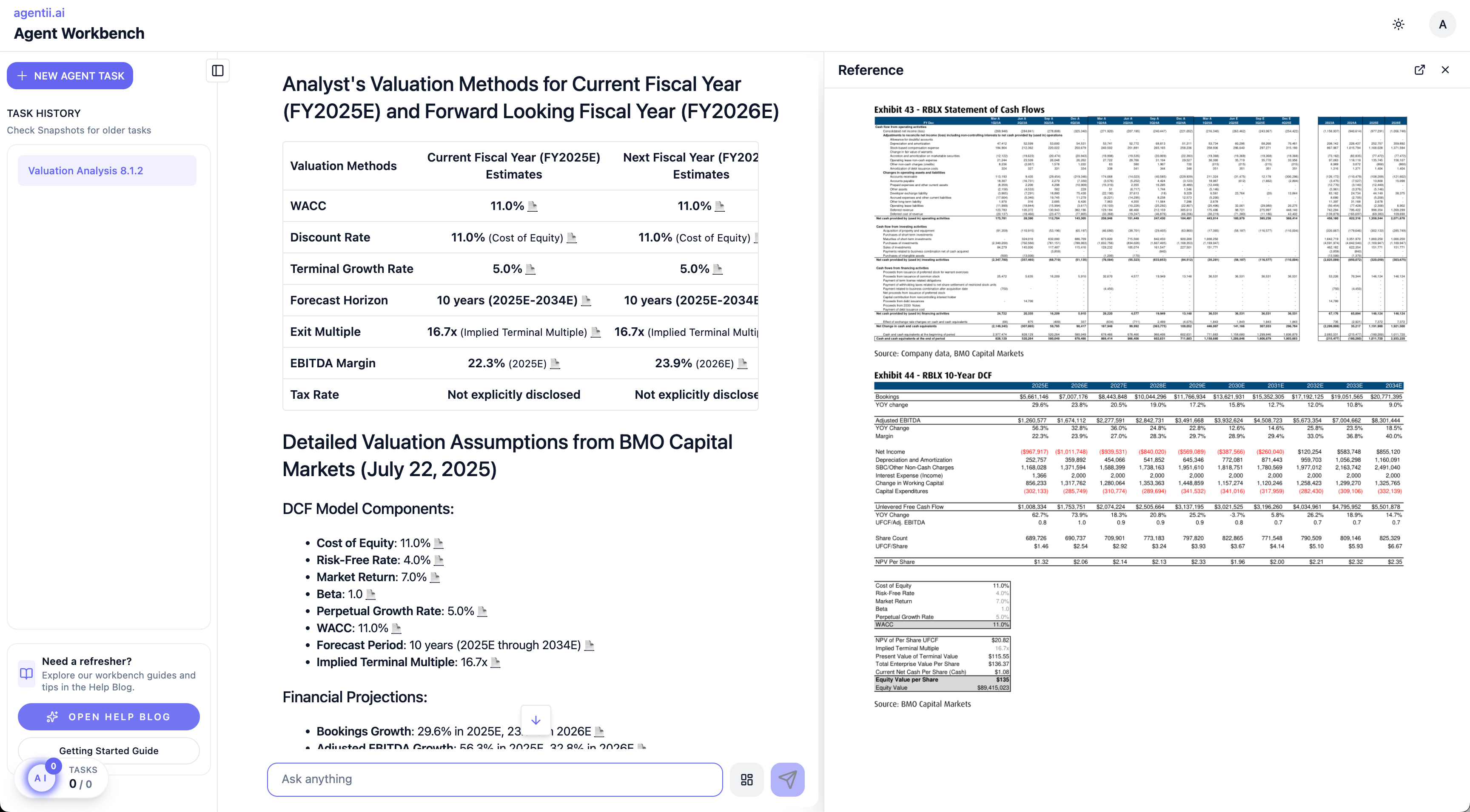
Core Feature 3: Research-First Interface and Workflow
Data quality and retrieval accuracy are necessary foundations—but how information is presented determines whether analysts can actually use it in their daily workflows.
Generic LLM chat interfaces were designed for conversational Q&A, not professional research. Agent Workbench's interface was built from first principles for investment analysis workflows—emphasizing tabular data, source citations, multi-document synthesis, and interactive exploration.
Tabular Data: Financial Analysis Lives in Tables
Professional investment research revolves around structured financial data: balance sheets, income statements, segment breakdowns, historical trends, peer comparisons.
Generic Chat Interface Problem: LLMs generate prose paragraphs. When an analyst asks for "Apple's revenue by segment over the past 4 quarters," ChatGPT returns:
"Apple's revenue by segment has shown strong growth across all categories. In the most recent quarter, iPhone revenue was approximately $40 billion, Services was around $22 billion, Mac was about $7 billion, iPad was roughly $6 billion, and Wearables was approximately $9 billion. Compared to prior quarters, iPhone revenue has grown modestly while Services continues to show strong double-digit growth..."
This prose narrative is:
- Hard to scan visually
- Difficult to copy into spreadsheets
- Impossible to sort or compare across dimensions
- Lacks precision ("approximately," "around," "roughly")
Agent Workbench Solution: Present financial data in interactive tables with:
| Quarter | iPhone | Services | Mac | iPad | Wearables | Total |
|---|---|---|---|---|---|---|
| Q3 2025 | $39.3B | $22.3B | $7.0B | $6.2B | $8.8B | $83.6B |
| Q2 2025 | $46.0B | $23.9B | $7.5B | $5.6B | $9.2B | $92.2B |
| Q1 2025 | $69.7B | $23.1B | $8.7B | $7.0B | $11.9B | $120.4B |
| Q4 2024 | $43.8B | $21.2B | $7.7B | $6.4B | $9.7B | $88.8B |
This tabular presentation:
- Enables visual scanning and pattern recognition
- Facilitates copy-paste into Excel models
- Supports sorting by any dimension (quarter, segment, growth rate)
- Provides exact numbers with decimal precision
- Includes growth calculations
- Links to authoritative sources with page numbers
Multi-Document Synthesis: Unified View Across Filings, Transcripts, and Research
Investment analysis requires synthesizing information across dozens of documents:
- 10-Q and 10-K filings (audited financials)
- 8-K current reports (material events)
- Earnings call transcripts (management commentary)
- Earnings releases (headline metrics)
- Sell-side research reports (analyst consensus)
- Expert interviews (proprietary insights)
Generic Chat Interface Problem: Each query retrieves from one document at a time. The analyst must manually ask follow-up questions, mentally track which information came from which source, and reconcile discrepancies manually.
Agent Workbench Solution: Instant multi-document synthesis that combines insights across all relevant sources into a unified narrative:
Example Query: "What risks does Apple face in China?"
Agent Workbench Synthesis:
Regulatory & Geopolitical Risks (10-K FY 2024, Risk Factors, page 12):
- "Changes in China's regulatory environment, including data localization requirements and restrictions on foreign technology companies, could materially impact our business operations and revenue"
Demand & Competitive Risks (Q3 2025 Earnings Call, Analyst Q&A, timestamp 23:15):
- CFO: "We're seeing softer demand in China due to macroeconomic headwinds and increased competition from domestic smartphone manufacturers"
Analyst Consensus (Sell-Side Research Synthesis, 8 reports, past 30 days):
- Consensus view: China revenue expected to decline 5-10% in FY 2025 vs. FY 2024 due to competitive pressure from Huawei and economic slowdown
- 3 analysts cite regulatory risk as primary concern; 5 analysts cite competitive dynamics
Expert Network Insights (Channel Check, 2 interviews, past 45 days):
- Retail partner in Shanghai: "Foot traffic down 15% YoY, customers increasingly considering domestic alternatives"
- Industry consultant: "App Store restrictions limiting revenue growth from China market"
Synthesis: Apple faces multi-faceted risks in China: (1) regulatory pressure from data localization and app restrictions, (2) demand softness from macro slowdown, and (3) competitive pressure from Huawei/Xiaomi/Oppo. Consensus expects 5-10% revenue decline in FY 2025. Management acknowledges softer demand but has not provided specific guidance on China trends.
This cross-document synthesis saves the analyst hours of manual research aggregation and ensures no critical insight is missed.
Source Citations: Auditability and Verification on Every Claim
Institutional investment research demands complete auditability. Every claim, every number, every conclusion must be traceable to authoritative sources.
Generic Chat Interface Problem: LLMs generate fluent prose without source attribution. When challenged, they can't point to specific documents or page numbers. Audit trails are impossible to reconstruct.
Agent Workbench Solution: Every claim links to its source with document identifier, page number, section, and timestamp:
Example Answer: "Apple's Q3 2025 services revenue grew 5.2% YoY to $22.3B."
Source Citation:
- Apple Inc. 10-Q Q3 2025, page 3, Consolidated Statements of Operations
- Apple Inc. Q3 2025 Earnings Release, page 1, Financial Summary
- Verified match: 10-Q ($22,314M) = Earnings Release ($22.3B) ✓
- Confidence: 0.98 (high agreement across sources, current data, audited filing)
This citation-first approach enables:
- Compliance teams to verify research methodologies
- Auditors to reconstruct analytical decision-making
- Analysts to drill into source documents for additional context
- Portfolio managers to trust AI-generated insights
Interactive Dashboards: From Analysis to Decision-Ready Visuals
Professional investment workflows move from data gathering → analysis → synthesis → presentation. The final step—communicating insights to portfolio managers, investment committees, or LPs—requires compelling visualizations.
Generic Chat Interface Problem: LLMs output text. Analysts must manually export data, import into visualization tools (Tableau, Excel), design charts, and iterate on formatting.
When Agent Workbench Isn't the Answer
Professional tools acknowledge their boundaries. Agent Workbench excels at data-driven investment research but isn't designed for:
1. Execution and Trading
Agent Workbench is a research platform, not a trading system. It doesn't execute trades, manage portfolios, or provide real-time market data feeds. Use it for pre-trade analysis, not order execution.
2. Compliance and Regulatory Filings
While Agent Workbench retrieves and analyzes SEC filings, it doesn't replace legal/compliance review. Investment memos, regulatory disclosures, and compliance documentation require human oversight.
3. Qualitative Judgment and Conviction
Agent Workbench provides data, verification, and synthesis—but investment conviction requires human judgment. Use AI insights to inform decisions, not replace decision-making.
4. Real-Time News and Market Sentiment (Currently Limited)
Current version focuses on structured financial data (filings, transcripts, research). Real-time news sentiment and social media analysis are roadmap features, not current strengths.
5. Novel Situations and Edge Cases
Agent systems perform best on well-documented scenarios. Unprecedented events (novel regulatory changes, first-of-kind M&A structures, emerging technologies) may require human expert analysis beyond AI capabilities.
6. Cost Considerations
Agentic search costs 10-30x more per query than basic RAG ($0.12-0.15 vs. $0.01 per query) due to multi-agent orchestration and iterative verification. For high-volume, low-stakes queries, this cost may not be justified. Agent Workbench is optimized for high-stakes, complex research—not casual browsing.
Who Should Use Agent Workbench?
Target Users: Professional US Stock Investors
Agent Workbench was built for:
1. Hedge Fund and Asset Management Analysts
- Covering 20-50+ companies per analyst
- Conducting earnings analysis every quarter (200+ companies per season)
- Building investment theses with multi-document research
- Presenting to portfolio managers and investment committees
Value Proposition: Reduce earnings analysis time from 4 hours/company to 30 minutes/company. Free 40% of research time from data gathering to focus on conviction and thesis development.
2. Portfolio Managers and Investment Directors
- Making allocation decisions across sectors and strategies
- Reviewing analyst recommendations with skeptical oversight
- Tracking portfolio holdings for material changes
- Responding to ad-hoc questions from LPs and stakeholders
Value Proposition: Get verified, cross-source answers to complex questions in seconds. Audit trail for every claim ensures defensible decision-making.
3. Solo General Partners and Independent Researchers
- Managing small funds (< $100M AUM) without large analyst teams
- Covering broad investment mandates across sectors
- Limited time for deep-dive research on every position
- Need institutional-quality analysis at lower cost
Value Proposition: Access institutional-grade data sources and analysis at fraction of Bloomberg Terminal + analyst team cost ($5K-10K/month vs. $100K+/month).
4. Semi-Pro Retail Investors (Prosumers)
- Experienced investors with 5+ years stock market investing
- Actively read financial statements and earnings calls
- Build detailed financial models in Excel
- Seek institutional-quality insights without institutional budgets
Value Proposition: Professional-grade research tools previously accessible only to hedge funds and asset managers. No prompting expertise required—ask questions in natural language.
Getting Started: Try Agent Workbench Today
Request an Invitation Code
Want to see Agent Workbench in action with your specific use cases?
Request an invitation code:
- Visit www.agentii.ai/request
- Fill out demo request form (name, email, firm, use case)
- Our team will reach out within 1 business day
Key Takeaways
1. Generic LLM chat tools fail professional investors due to 30% accuracy, lack of source verification, temporal confusion, and no audit trails. Investment research demands institutional-grade precision.
2. Agent Workbench solves accuracy through three core features: (a) Institutional data sources (SEC filings, earnings calls, sell-side research, expert networks), (b) 99% accurate agentic search (multi-agent orchestration with 6-stage verification), and (c) Research-first interface (tabular data, source citations, interactive dashboards).
3. Agentic search achieves 95%+ accuracy through iterative verification—decomposing queries, cross-validating across sources, checking units and time periods, validating business logic, and scoring confidence before presenting answers. ( 99% accuracy on financial benchmarks updated in Nov. 2025)
4. Professional workflows demand tables, not prose. Agent Workbench presents financial data in interactive tables with exact numbers, sort/filter capabilities, and copy-paste Excel integration.
5. Auditability is non-negotiable. Every claim links to authoritative source with page number, timestamp, and confidence score—enabling compliance review and regulatory defensibility.
6. Agent Workbench is for professional investors: hedge fund analysts, portfolio managers, solo GPs, and prosumers who need institutional-quality research without institutional budgets.
Conclusion: The Future of Investment Research is Agentic
For decades, professional investment research has been constrained by a fundamental trade-off: depth vs. coverage. Analysts could either (1) conduct deep, multi-source research on 10-20 companies, or (2) maintain surface-level coverage on 50-100 companies—but not both.
Agent Workbench breaks this trade-off.
By combining institutional-grade data sources, 99% accurate agentic search, and research-native workflows, Agent Workbench enables analysts to conduct institutional-quality research at 10x the scale and 1/10th the time—freeing 40% of their workload from data gathering to focus on conviction, thesis development, and decision-making.
This isn't about replacing analysts. It's about amplifying what professional investors do best: synthesize disparate information, identify mispriced opportunities, develop differentiated theses, and make high-conviction investment decisions.
The future of investment research isn't generic chatbots hallucinating plausible-sounding answers. It's agentic AI systems that verify every claim, cite every source, and deliver institutional-grade accuracy at consumer-friendly prices.
Ready to transform your investment research workflow?
- Start free trial: www.agentii.ai/workbench
- Request an invitation: www.agentii.ai/request
- Questions? Email us at sales@agentii.ai
About the Author
Frank Agentii is Co-founder of Agentii, a company building production-ready agentic AI systems for institutional investors. Before Agentii, he spent years working on AI systems for large public companies and quantitative trading firms, specializing in multi-agent orchestration, retrieval systems, and ensuring AI reliability for high-stakes financial applications.
Further Reading
- Achieving 99% Accuracy in Financial AI: Why Agentii Chose Agentic Search Over RAG - Technical deep-dive into agentic search architecture
- Agent Workbench Documentation - User guides, API reference, integration tutorials
- Agentii Platform Overview - Product features, pricing, and customer stories
Disclaimer: This blog post is for informational and educational purposes only. It does not constitute investment advice, financial advice, or a recommendation to buy or sell any securities. Past performance is not indicative of future results. Investors should conduct their own due diligence and consult with qualified financial advisors before making investment decisions.